Author

Decisions for admission in accommodation places for asylum applicants, as well as for exit from or modification of the place of residence, are taken by OFII after consultation with the Director of the place of accommodation. The specific situation of the asylum applicant must be taken into account.
Accommodation facilities for asylum applicants under the national reception scheme (dispositif national d’accueil, DNA) are the following:
- Accommodation centres for asylum applicants (CADA);
- Emergency accommodation for asylum applicants (HUDA, AT-SA, PRAHDA, Reception and orientation centres (CAO, Centre d’accueil et d’orientation));
- Reception and administrative situation examination centres (CAES).
Asylum applicants accommodated in these facilities receive an address certificate (attestation de domiciliation).[1] This certificate is valid for one year and can be renewed if necessary. It allows the asylum applicant to open a bank account and to receive mail.
According to the national reception scheme principle, an asylum applicant who has registered their claim in a specific Prefecture might not necessarily be accommodated in the same region. The asylum applicant has to present themselves to the accommodation place proposed or the region assigned by OFII within 5 days. If not, the offer is considered to be refused and the asylum applicant will not be entitled to any further material reception conditions.
The management of reception centres is subcontracted to the semi-public company Adoma or to NGOs that have been selected through a public call for tender, such as Forum réfugiés, France terre d’asile, l’Ordre de Malte, Coallia, French Red Cross, etc. These centres fall under French social initiatives (action sociale) and are funded by the State. Their financial management is entrusted to the Prefect.
| Number of funded accommodation places by type: 2021-2026 | ||||||
| Type of accommodation | 2021 | 2022 | 2023 | 2024 | 2025 | 2026 |
| CADA | 46,632 | 46,632 | 49,242 | 49,086 | 50,448 | 61,963 |
| HUDA | 52,160 | 52,160 | 52,950 | 47,708 | 43,322 | 28,923 |
| CAES | 5,122 | 6,622 | 6,622 | 5,627 | 5,446 | 4,580 |
| Total | 103,914 | 105,414 | 108,814 | 102,421 | 100,224 | 95,466 |
Source: Ministry of Interior, ‘Debate on immigration: Press kit, 6 December 2022, available in French at: https://bit.ly/3ZBgeBs. Budget law 2024, Annex on Immigration, Asylum, Integration, October 2023, available in French at: https://bit.ly/4ct0VT5. Ministère de l’Intérieur, ‘Progammation budgétaire 2025 du parc d’hébergement des demandeurs d’asile et des réfugiés’, 13 November 2024, available in French here ; Budget law 2026, Annex on Immigration, Asylum, Integration, October 2025, available in French here; La Cimade,, ‘Premier bilan du DNA 2025’, February 2026, available in French here.
In 2025, the number of asylum applicants accommodated remained far below the number of persons registering an application. At the end of the year, the Ministry of Interior stated that 70% of asylum applicants eligible to material reception conditions – i.e., 90,536 persons in total at the end of December 2024 according to OFII[2] – should effectively be accommodated (compared to 71 % at the end of 2024)[3] i.e. about 64,760 persons. If we add asylum applicants who do not benefit from reception conditions, we can consider that about 88,000 asylum applicants were not accommodated in dedicated places in France as of the end of 2025 (according to Eurostat, 153,090 asylum applications were pending in France at the end of 2025) – a part of them (unknown) however did not express the need to be accommodated.
| Part of asylum seekers without any accommodation | |||||||
| 2018 | 2019 | 2020 | 2021 | 2022 | 2023 | 2024 | 2025 |
| 99.3% | 94.2% | 96.1% | 77.1% | 70.4% | 69.9% | 61.3% | 59.1% |
ECRE’s report on the reception conditions of refugees and asylum applicants in Europe demonstrates that France has consistently fallen short of its obligations to provide accommodation to all asylum applicants on its territory, despite a considerable expansion of its reception infrastructure and a proliferation of types of accommodation.[4] The following figures provides an overview of the evolution of pending applications and capacity in France.
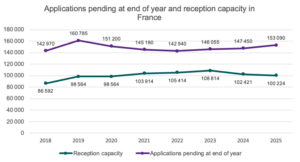
| 2018 | 2019 | 2020 | 2021 | 2022 | 2023 | 2024 | 2025 | |
| Applications pending at end of year | 86,592 | 98,564 | 98,564 | 103,914 | 105,414 | 108,814 | 102,421 | 100,224 |
| Reception capacity | 142,970 | 160,785 | 151,200 | 145,180 | 142,940 | 146,055 | 147,450 | 153,090 |
This shows that a substantial number of applicants were left out of accommodation almost every year. These persisting issues raise questions of compliance with the Reception Conditions Directive as reception conditions should ensure an adequate standard of living for applicants. The decrease of first-time applicants in 2020 is largely due to the impact of COVID-19 and further does not reflect the fact that reception capacity was still very much lacking, given that many other asylum applicants were already present on the territory.
In practice, there is a discrepancy between the type of places available and the reality of asylum applicants in France. Many reception centres have been organised so as to receive families or couples, thereby making it difficult for single men or women to be accommodated. A 2023 parliamentary report contrasts this with the fact that, at least in the context of regional orientation, 61.8% of asylum applicants were single men, 27.1% families and 11.1% single women, while of the 3,000 empty accommodation units available in July 2021 (corresponding to 5,000 people), 71% were places designed to accommodate families.[5] At the national level, in 2023, 41.6% of accommodated people were single persons and 58.4% were part of a family.[6]
Moreover, if the asylum applicant has not succeeded in getting access to a reception centre before lodging their appeal, the chances of benefitting from one at the appeal stage are very slim. In case of a shortage of places, asylum applicants may have no other solutions than relying on night shelters or living on the street. The implementation of the national reception scheme intends to avoid as much as possible cases where asylum applicants are homeless or have to resort to emergency accommodation in the long run, yet gaps in capacity persist.
In December 2025, 9.6% of the places in accommodation centres were occupied by individuals who were no longer authorised to occupy these places such as rejected asylum applicants (3.7%) or beneficiaries of international protection (5.9%) after the period of authorised presence.[7] Moreover, 2.5% of the places were not occupied (e.g., due to works, delays in orientation etc.).[8]
Following a reduction in budgetary funding, that led to places being closed in 2025, the Budget Law for 2026 provides yet again for the funding cut which would reduce the number of places in reception system by approximately 5,000 places.[9]
Overseas France: At the end of 2023, there were 727 places in Guiana, 500 places in Mayotte, 95 in Réunion Island, 30 in Martinique, and 22 in Guadeloupe, all in emergency shelter (HUDA) – total 1,374 places in overseas territories.[10] No data is available for 2024; they were about 900 places in Mayotte at the end of 2025.
Reception centres for asylum applicants (CADA)
Asylum applicants having registered an application for international protection are eligible to stay in reception centres. Asylum applicants under a Dublin procedure are excluded from accessing these centres. CADA can be either collective or individualised housing, within the same building or scattered in several locations. A place in the centres for asylum applicants is offered by OFII once the application has been made.
At the end of 2025, out of a total 46,484 people accommodated in CADA:[11]
- 2,951 were beneficiaries of international protection staying unauthorised;
- 1,832 were rejected asylum applicants staying unauthorised.
Emergency reception centres
Given the lack of places in regular reception centres for asylum applicants (CADA), the State authorities have developed emergency schemes. Different systems exist:
- A decentralised emergency reception scheme: emergency accommodation for asylum applicants (hébergement d’urgence dédié aux demandeurs d’asile, HUDA), with 39,128 emergency accommodation places at the end of 2025[12] (including 1,008 places in overseas territories). Capacities provided by this scheme evolve quickly depending on the number of asylum claims and capacities of regular reception centres. Some of these places are in hotel rooms.
- The reception and accommodation programme for asylum applicants (programme regional d’accueil et d’hébergement des demandeurs d’asile, PRAHDA), managed at the national level. It consists of housing, in most cases in former hotels, for 5,202 persons who have applied for asylum or who wish to do so and who have not been registered.
Asylum applicants who fall under the Dublin procedure in France can in theory benefit from emergency accommodation up until effective transfer, while Dublin returnees are treated as regular asylum applicants and therefore benefit from the same reception conditions granted to asylum applicants under the regular or the accelerated procedure. In practice, however, many persons subject to Dublin procedures (applicants or returnees) live on the streets or in squats because of the overall lack of places. At the end of 2025, only 4,887 out of 24,174 asylum applicants under Dublin procedure this year were accommodated (20.2%).[13] No such detailed data are available for 2024.
Reception and administrative situation examination centres (CAES)
A new form of accommodation emerged in 2017 called Reception and Administrative Situation Examination Centres (centres d’accueil et d’examen de situation administrative, CAES). They combine accommodation with an examination of the person’s administrative situation, in order to direct the individual to other accommodation depending on where they fall between an asylum procedure, a Dublin procedure or a return procedure. Almost 3,000 places in such shelters were created in 2018 and many other places in the following years. There was a total of 5,446 places funded at the end of 2025.[14] In some regions, CAES are designed for people coming from camps in and around Paris, while in others they benefit vulnerable asylum applicants whose application has been registered, pending referral to CADA or emergency reception.
In 2023, a new accommodation system with 500 places called ‘SAS d’accueil’ régionaux’ has been set up to allow the accommodation of homeless people evacuated from Paris to other regions, but it is not specifically dedicated to asylum applicants (in practice, many asylum applicants are accommodated there).[15] It also allows an examination of the situation before referral to the appropriate device. During the first six months of activity, the media reported that 1,600 people were referred to these SAS, but 20% of them left without having been transferred to a durable solution corresponding to their administrative situation.[16] According to La Cimade, based on official figures, out of 6,500 invitations to go to these places, 2,572 people refused outright or did not show up for the bus taking them there. Among the 3,928 people admitted, 2,200 people were asylum applicants, 1,021 were refugees, 511 were in an irregular situation and 196 were in another situation. 42% of referrals were made to the national reception system for asylum applicants and 43% to the emergency accommodation system and 15% left before the end. Among those housed in the general system, 36% are still in the system, 30% were no longer supported, 16% had left it, 13% had been referred to another accommodation.[17] No more recent detailed data of this type are available. Evacuations to SAS continued in 2025.
Asylum applicants left without accommodation
Despite the increase in reception capacity and creation of new forms of centres, a number of regions continue to face severe difficulties in terms of providing housing to asylum applicants. As stated above, only about 70% of asylum applicants eligible for material reception conditions were accommodated at the end of 2025.[18] The shortcomings of the French reception system were condemned in December 2022 by the UN Committee on the elimination of racial discrimination.[19] People have no choice but to turn to squalid living conditions, including in informal camps, which are regularly dismantled by the authorities, with or without a planned accommodation solution.
In Paris, from 2019 to end of 2021, 27,508 migrants were evacuated from camps and accommodated through 109 operations carried out by the authorities, [20] including a violent evacuation in November 2020 widely condemned by NGOs, media and politicians.[21] In 2022, 6,668 persons were evacuated from the Parisians camps.[22] In 2023, 6,443 persons were evacuated.[23] Precise figures for the whole of 2024 and 2025 are not available, but evacuation operations were still common in 2025.[24] A coordination unit to deal with these situations was set up in January 2021, bringing together the authorities and associations.[25] At the end of November 2025, the NGO France terre d’asile counted 663 tents in the capital’s main encampment areas, which would represent between 985 and 1,723 people (the highest level in six years). The City of Paris also recorded 1,754 people living on municipal sites or in sports halls.[26] The implementation of a national reception scheme, allowing better orientation from the Paris region to accommodation in other regions, enabled the orientation of 36,106 migrants in 2021 and 2022. However, some NGOs report numerous cases of people who could not be accommodated following these operations or who were placed in detention.[27]
In Calais, regular dismantlement operations have been carried out since 2015, as described in the previous updates of this report.[28] Yet, hundreds of migrants were still living in makeshift camps in Calais area throughout 2024. At the end of 2024, media reported that about 1,000 migrants were in Calais and its surroundings.[29] Following a visit to the informal camp in Calais in September 2020, carried out upon the request from 13 NGOs, the Ombudsperson noted sub-standard living conditions.[30] A report published by Human Rights Watch in 2021 stated that people living in camps in Calais and surroundings have still an insufficient access to basic needs, such as access to water point, food supply, health care, and sanitary facilities.[31]
Furthermore, in reaction to the sinking of a small boat during the Channel crossing on 24 November 2021, in which 27 persons died, the Ombudsperson reiterated its previous recommendations made in 2015 and 2018. It asked for the halt of systematic dismantlement in Calais, which appears to be done in complete violation of migrant’s fundamental rights. It also underlined that every dismantlement should strictly respect procedures, human dignity and research for durable accommodations.[32]
In its annual report published in June 2022, Human Rights Observer (HRO), an organisation which monitors police evictions in northern France, stated that 1,226 dismantlement operations took place in Calais and 61 in Grande-Synthe throughout 2021.[33] During all these operations, HRO stated that 10,121 tents were seized, 205 people were arrested, and 127 migrants were victims of police brutality.[34] During a dismantlement at the end of December 2021, confrontations were reported between police officers and migrants. During the operation, 15 police officers and 3 migrants were injured. At the beginning of January 2022, a substantial police operation was organised in the same place, to complete the dismantlement. About 100 police officers were deployed in order to evacuate a camp of 50 migrants.[35] An investigation published by a journalist at the beginning of 2023 confirms the persistence of violence and police harassment in the Calais region in order to avoid the establishment of camps.[36] In 2023 (until December), 16,041 persons were, in some cases forcibly, evacuated or evicted by authorities in this region.[37] In 2025, a local NGO counted about 4,000 evacuations in Calais (compared to 5,847 in 2024) and 4,965 in Grande-Synthe (compared to 2,129 in 2024) in 2024.[38] Another NGO counted at least 162 evictions from living quarters in Calais and 42 in the Dunkirk area.[39]
On 16 November 2021, one of the largest dismantlement operations happened in Grande-Synthe. Approximately 1,200 persons were evacuated, during a substantial operation involving more than 300 police officers. NGOs stated that this large operation has led to placements in accommodations centres for all the persons involved, but under duress, and without any interpreter to inform them of the implication of this procedure.[40]
Police operations sometimes involve a very large number of people. For example, on 30 November 2023, 1,244 persons were evacuated from camps in the North of France.[41] Some NGOs denounced repressive action which did not take into account the wishes of the people and did not constitute a lasting solution.[42]
In recent years, courts and stakeholders have also condemned the situation in Calais. In July 2017, the Council of State ruled that State deficiencies in Calais exposed migrants to degrading treatment and ordered the State to set up several arrangements for access to drinking water and sanitary facilities.[43] In a report published in December 2018, the Ombudsperson denounced a “degradation” of the health and social situation of migrants living in camps in the north of France, with “unprecedented violations of fundamental rights”.[44] On 21 June 2019, the Council of State ordered the northern prefecture of France to adopt important sanitary measures to support around 700 migrants living near a sport hall in the commune of Grande-Synthe. The application for interim measures had been filed by 9 civil-society organisations and the commune of Grande-Synthe. It demonstrated that both the inhumane living conditions of the migrants and the failure to act of the Government were a violation of the migrant’s fundamental rights.[45] For further information on the situation in previous years, see previous updates to this country report available here.
In November 2025, six organisations announced that they had taken legal action against the French government for violating the human rights of the more than 2,000 migrants who are “surviving” in temporary camps around Dunkirk, notably in Loon-Plage and Grande-Synthe. They are calling for access ’to hygiene, food, healthcare and accommodation’ for all these people.[46]
In some other cities (Nantes, Lyon, Bordeaux, Metz) migrants often live in the street. Some of them are asylum applicants eligible for accommodation centers but not housed due to the lack of places. The issue of homelessness in France has also been scrutinised by the European Court of Human Rights (ECtHR). On 2 July 2020, the ECtHR published its judgment in N.H. and others v France concerning the living conditions of homeless asylum applicants as a result of the failures of the French authorities. The case concerns 5 single men of Afghan, Iranian, Georgian and Russian nationality who arrived in France on separate occasions. After submitting their asylum applications, they were unable to receive material and financial support and were therefore forced into homelessness. The applicants slept in tents or in other precarious circumstances and lived without material or financial support, in the form of Temporary Allowance, for a substantial period of time. All of the applicants complained, inter alia, that their living conditions were incompatible with Article 3 ECHR.[47] However, in the case of B.G. and others v. France, the ECtHR unanimously ruled on 10 September 2020 that, inter alia, the living conditions in a French tent camp on a carpark did not violate Article 3 ECHR.[48]
Overseas France: In Guiana, authorities have implemented an ‘official’ camp with about 400 persons.[49] An informal settlement of 150 people (‘La Verdure’) was dismantled in July 2025, enabling 70 to 80 people to be provided with shelter.[50]
In Mayotte, hundreds of asylum applicants and refugees had set up camp at the Cavani stadium in Mamoudzou. 308 refugees were evacuated on 25 February 2024 to be transferred to the mainland, with 410 people remaining there.[51] A final evacuation operation in August 2024 resulted in the accommodation of the remaining[52][53]
Evolution of the capacity of the different types of accommodation
Although the capacity of CADA – the main form of reception for asylum applicants – has been steadily developed throughout the years, France has exponentially increased the capacity of emergency accommodation through the creation of PRAHDA and the expansion of local HUDA from 11,829 places in mid-2016 to 43,322 places at the end of 2025.[54] However, the Ministry of Interior has launched a plan to convert HUDA places into CADA places from 2025 onwards, which will have a significant impact from 2026 onwards as it will affect more than 12,000 places.
This means that the emergency accommodation network (PRAHDA, HUDA) is more important than the CADA and formally forms part of the national reception system. It appears therefore that “emergency accommodation” in France no longer serves the purpose of temporarily covering shortages in the normal reception system. In fact, as already explained, it is the default form of accommodation for certain categories of asylum applicants such as those under a Dublin procedure, since they are excluded altogether from CADA.[55]
[1] Article R. 551-7 to R. 552-3 Ceseda.
[2] OFII, Publication on X, February 2026.
[3] Budget law 2026, Annex on Immigration, Asylum, Integration, October 2025, available in French here.
[4] ECRE, Housing out of reach? The reception of refugees and asylum seekers in Europe, April 2019, available at: https://bit.ly/2RK0ivp, 13.
[5] Assemblée nationale, Rapport fait au nom de la Commission des finances sur l’orientation directive, 24 May 2023, available in French at: https://bit.ly/3PCMCS0.
[6] OFII, ‘Rapport d’activité 2023’, December 2024, available in French here.
[7] La Cimade, ‘Premier bilan du DNA 2025’, February 2026, available in French here.
[8] La Cimade, ‘Premier bilan du DNA 2025’, February 2026, available in French here.
[9] Budget law 2026, Annex on Immigration, Asylum, Integration, October 2025, available in French here.
[10] Instruction du 19 avril 2023 relative au pilotage du parc d’hébergement des demandeurs d’asile et des Réfugiés en 2023 NOR : IOMV2305068J, available in French at: https://bit.ly/4azAutf;
[11] La Cimade, ‘Premier bilan du DNA 2025’, February 2026, available in French here.
[12] La Cimade, ‘Premier bilan du DNA 2025’, February 2026, available in French here.
[13] La Cimade, ‘Premier bilan du DNA 2025’, February 2026, available in French here.
[14] La Cimade, ‘Premier bilan du DNA 2025’, February 2026, available in French here.
[15] Lignes directrices pour la prise en charge administrative et l’orientation des personnes mises à l’abri au sein de sas d’accueil temporaire, NOR : IOMK2305900, 13 March 2023, available in French at: https://bit.ly/3xdml6C.
[16] France Info, ‘ENQUETE. JO 2024 : comment les migrants à la rue sont évacués de Paris vers des “sas d’accueil temporaires régionaux”’, 14 September 2023, available in French at: https://bit.ly/4cB1Dxu.
[17] La Cimade, ‘Vers un nouveau schéma national d’accueil: orientations directives et refus des conditions matérielles d’accueil’, 12 March 2024, available in French at : https://bit.ly/3TTEm2z.
[18] Budget law 2026, Annex on Immigration, Asylum, Integration, October 2025, available in French here.
[19] CERD/C/FRA/CO/22-23, 14 December 2022, available in French at : https://bit.ly/3NqoyBG, para. 19.
[20] Assemblée nationale, Rapport fait au nom de la Commission des lois sur le projet de loi de finances 2023, 6 October 2022, available in French at: https://bit.ly/3Zr39e5.
[21] Le Monde, ‘Le point sur l’évacuation du camp de migrants à Paris : coups de matraque et « chasse à l’homme », indignation politique et enquêtes de l’IGPN’, 24 November 2020, available in French at: https://bit.ly/3rVwdKr.
[22] Préfecture de la région Ile-de-France, Press release, 9 February 2023, available in French at : https://bit.ly/3PDfvxF.
[23] Préfecture de la région Ile-de-France, Press release, 12 December 2023, available in French at : https://bit.ly/3TQIHnh.
[24] See e.g. AFP, ‘Les migrants installés sur le parvis de l’Hôtel de ville à Paris évacués’, 12 August 2025, available in French here.
[25] Préfecture de la région Ile-de-France, Communiqué de presse : Installation de la cellule de coordination pour l’accueil et l’accompagnement des migrants, 18 January 2021, available in French at: https://bit.ly/34aJ2Kz.
[26] Le Monde, ‘A Paris, le nombre de sans-abri dans les campements au plus haut depuis six ans’, 17 December 2025, available in French here.
[27] See e.g., Utopia 56, ‘Paris : réponse sécuritaire à une urgence humanitaire’, Press release, 29 October 2021, available in French at: https://bit.ly/3IEVa5j. Le Revers de la Médaille, ‘1 an de nettoyage social avec les JOP 2024’, June 2024, available in French here; Observatoire des expulsions, Rapport annuel, December 2024, available in French here.
[28] See e.g. : Le Monde, ‘A Calais et à Dunkerque, plusieurs camps de migrants évacués par la police‘, 30 November 2023, available in French at : https://bit.ly/3Ts2M1O. See also, previous AIDA Country Reports: France, available at: https://bit.ly/3KLYFJo.
[29] Infomigrants, ‘À Calais, les démantèlements de campements s’accélèrent et fragilisent les migrants’, 28 November 2024, available in French here.
[30] Défenseur des droits, Decision No. 2020-179, 18 September 2020, available in French at: https://bit.ly/3rTYmkP.
[31] Human Rights Watch, Infliger la détresse : Le traitement dégradant des enfants et des adultes migrants dans le nord de la France, October 2021, available in French at: https://bit.ly/3t2NAfw.
[32] Défenseur des droits, Communiqué de presse. Calais : la Défenseure des droits rappelle l’urgence d’une politique d’accueil respectant les droits fondamentaux des personnes exilées, 25 November 2021, available in French at: https://bit.ly/3JcutHd.
[33] Human Rights Observer, Activity report 2021, June 2022, available at: https://bit.ly/3UGtBPQ.
[34] Human Rights Observer, Data for 2021, available in French at: https://bit.ly/3xdcEF8.
[35] France 3 Région, 2 janvier 2022, « Calais : après les affrontements de jeudi, les policiers reviennent en force pour déloger les migrants du même camp », available in French at: https://bit.ly/3KBmzpr.
[36] L. Witter, ‘La battue’, February 2023, Le Seuil.
[37] France Bleu, ‘La police évacue deux camps de migrants à Calais et Dunkerque’, 30 November 2023, available in French at : https://bit.ly/3VBa1Hj.
[38] Human rights observers, ‘Observations mensuelles’, available here.
[39] Utopia 56, ‘Bilan 2025 à la frontière franco-britannique : des fausses réponses politiques et une situation humanitaire qui s’empire’, 18 February 2026, available in French here.
[40] Utopia 56, ‘Open letter to those responsible for the last expulsions in Grande-Synthe’, 24 November 2021, available in French at: https://bit.ly/3KBBn7o.
[41] See e.g ; : Le Monde, ‘A Calais et à Dunkerque, plusieurs camps de migrants évacués par la police‘, 30 November 2023, available in French at : https://bit.ly/3Ts2M1O.
[42] France 3, ‘Importante opération d’évacuation dans des camps de migrants à Calais et à Loon-Plage’, 30 November 2023, available in French at: https://bit.ly/3IUYr2c.
[43] Council of State, Order No 412125, 31 July 2017, available in French at: https://bit.ly/3ULoNci.
[44] Ombudsperson, ‘Exilés et droits fondamentaux, trois ans après le rapport Calais’, 19 December 2018, available at: https://bit.ly/3TSm3uy. n practice, in practices varies widely. er day to 25 €)ype of , 19 e of persons selected but it appears through OFII communic
[45] France TV Info, ‘Nord : la préfecture condamnée à prendre des mesures sanitaires et à organiser des maraudes pour les migrants à Grande-Synthe’, 21 June 2019, available in French at: https://bit.ly/2w0zPTL.
[46] InfoMigrants, ‘Nord de la France : six associations attaquent l’État en justice pour “non respect des droits humains” envers les migrants’, 19 November 2025, available in French here.
[47] European Court of Human Rights published, N.H. and others v France (Application No. 28820/13), 2 July 2020, see EDAL summary at: https://bit.ly/3ppxQhw.
[48] ECtHR, B.G. and others v. France (Application no. 63141/13), 10 September 2020, see EDAL summary at: https://bit.ly/37eckGi.
[49] La Cimade, ‘En Guyane, un camp pour les demandeurs d’asile géré par l’État’, 11 December 2023, available in French at : https://bit.ly/4a87qch.
[50] FranceGuyane, ‘Une opération de relogement menée à la Verdure, confusion chez les réfugiés’, 23 July 2025, available in French here.
[51] Préfet de Mayotte, ‘Operation de demantelement du stade de Cavani’, 26 February 2024, available in French at: https://bit.ly/3TSNa8N.
[52] France Info, ‘La préfecture annonce la fin de l’évacuation des migrants à Cavani’, 14 August 2024, available in French here.
[53] Infomigrants, ‘”Beaucoup de gens rentrent dans le camp, mais personne n’en sort” : à Mayotte, plus de 800 migrants vivent dans des conditions insalubres’, 22 December 2025, available in French here.
[54] La Cimade, ‘Premier bilan du DNA 2025’, February 2026, available in French here.
[55] Ibid.